


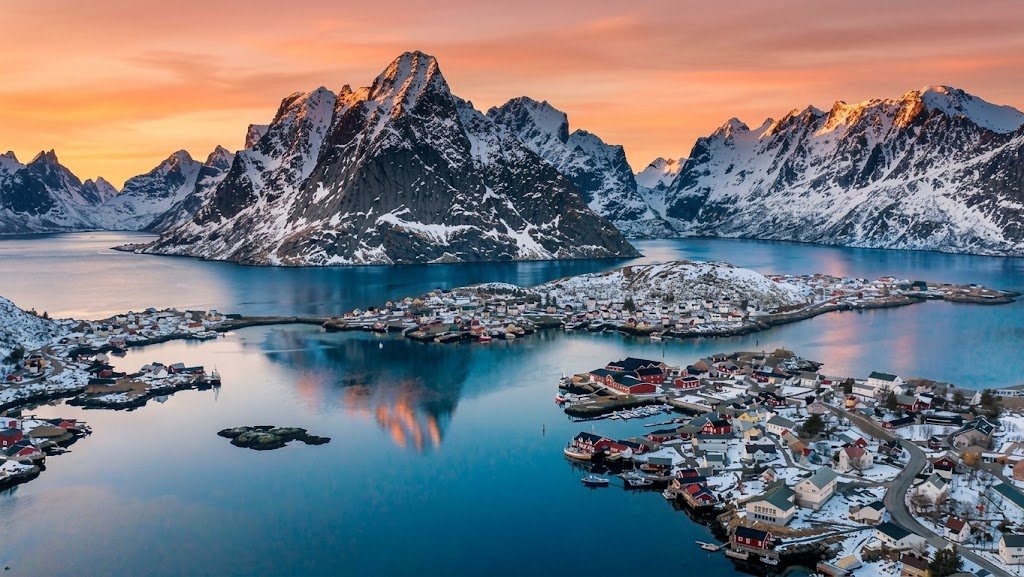
There is something almost unreal about arriving in the Lofoten Islands in winter. The mountains rise sharply from the sea, small fishing villages cling to the shoreline, and the light seems to behave differently from anywhere else. Some days are washed in deep blue. On others, the mountains catch a faint pink glow before disappearing back into the darkness.
Then, if the weather is kind, the Northern Lights arrive.
This is Lofoten in winter—quiet, dramatic and a little wild. It is not the easiest season to visit, but that is part of its charm. The islands feel less like a postcard and more like a real place where people continue to fish, work and live through the Arctic winter.

A Different Kind of Winter Landscape
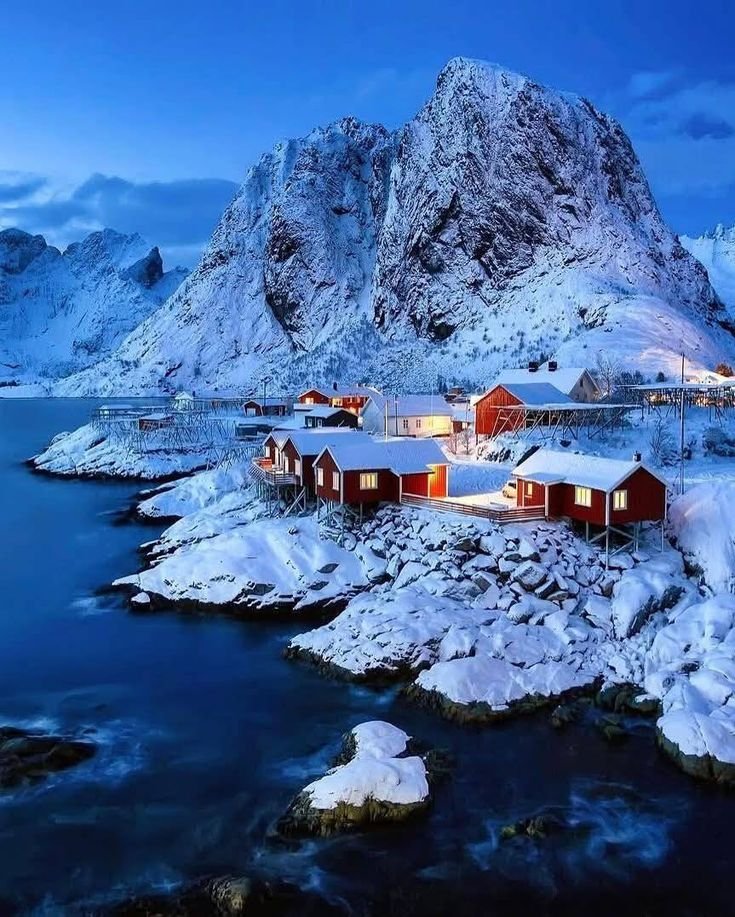
The Lofoten Islands sit above the Arctic Circle in northern Norway, around 68 degrees north. Winter generally runs from November through March, with January to March offering the most reliable chance of snow, although conditions can change considerably from year to year.
The cold is not always as extreme as you might imagine. The Gulf Stream helps keep the coastal climate relatively mild for its latitude, but the weather can turn quickly. A perfectly calm morning can become windy and snowy by afternoon.
That unpredictability gives the landscape much of its character.
One minute you are driving beside dark blue water. The next, snow is blowing across the road and the mountains have disappeared behind clouds.
You simply learn to slow down.
Reine Looks Like a Painting
Few places capture the beauty of the Lofoten Islands quite like Reine.
The small fishing village is surrounded by steep mountains, islands and fjords, with traditional red and yellow fishermen’s cabins scattered around the waterfront. Around 300 people live in Reine, and fishing remains an important part of the local economy.
In winter, the familiar summer photographs take on a completely different mood.
Snow settles on the mountains. The water becomes almost black beneath a pale sky. Smoke rises from cabins, boats move through the harbor and, after dark, there is a chance that green light will begin to appear overhead.
It is easy to understand why Reine has become one of Norway’s most photographed fishing villages.
But visiting in winter also means remembering that it is not simply a scenic backdrop. It is a working community. The roads are narrow, fishing continues and local people still go about their daily lives.
When the Sky Comes Alive
For many travelers, the Northern Lights are the reason to visit Lofoten during winter.
The islands sit beneath the auroral oval, making them particularly well placed for seeing the aurora. The season generally stretches from late August into April, although winter offers the darkness needed for longer viewing opportunities.
There is no guarantee, of course.
You need darkness and clear skies, and solar activity also needs to cooperate. Some nights produce nothing more than clouds. On another night, the sky can suddenly erupt in green, sometimes with hints of red or purple.
That unpredictability is part of the experience.
The best advice is not to build an entire trip around one specific night. Give yourself several evenings if possible, check the weather and consider joining a local Northern Lights tour. Local guides know the roads, viewpoints and changing weather patterns far better than a first-time visitor.
Winter Is Fishing Season
The winter story of Lofoten is not only about the Northern Lights.
It is also about fish.
From January to April, Arctic cod known as skrei migrate toward the waters around Lofoten to spawn. The seasonal fishery has shaped the islands for centuries and remains an important part of local life.
This is why winter can be such an interesting time to visit.
Walk through villages such as Henningsvær, Nusfjord or Å and you may see traditional wooden drying racks filled with cod. These structures, known as hjell, are not decorative props for visitors. They are part of a fishing tradition that has helped define Lofoten for generations.
In Å, the Norwegian Fishing Village Museum offers a closer look at this history, with preserved buildings including a boathouse, fisherman’s cabin, bakery and cod liver oil factory.

The Blue Hour
Perhaps the most beautiful thing about winter in Lofoten isn’t actually the Northern Lights.
It is the daylight.
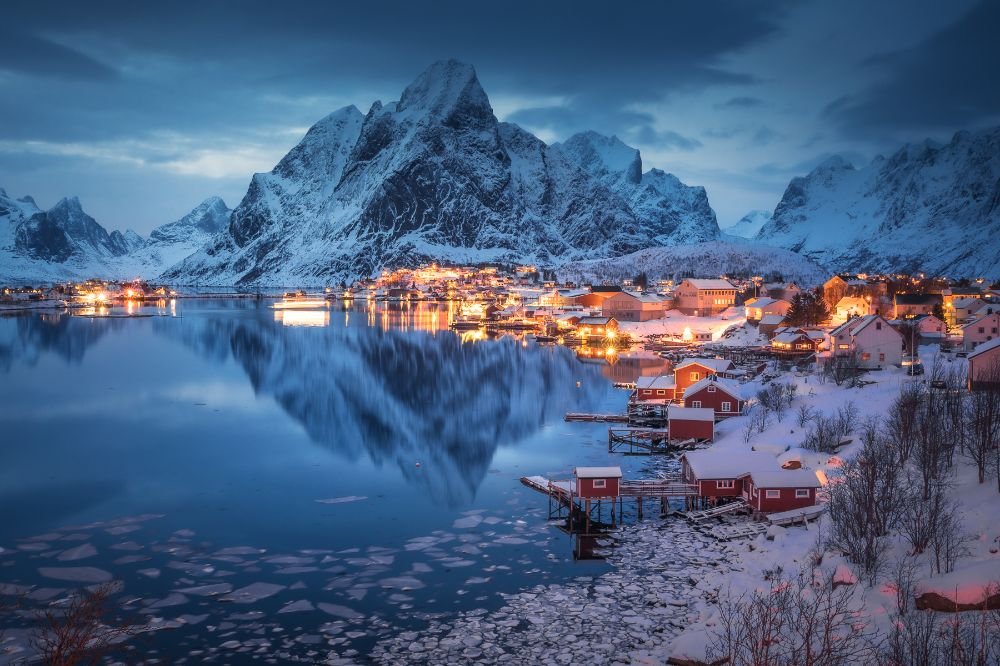
Around the darkest part of winter, the sun remains below the horizon, but the islands are not completely black. Instead, the sky can glow in shades of deep blue, pink and violet around midday. Locals call this period the blue hour, and it can last long enough to transform an ordinary harbor into something almost dreamlike.
For photographers, it is extraordinary.
For everyone else, it is simply beautiful.
A Winter Trip That Rewards Patience
The Lofoten Islands are not a destination where everything can be perfectly scheduled.
Weather can cancel plans. Roads can become difficult. The Northern Lights might refuse to appear. A boat trip may need to be postponed.
But that is also what makes the journey memorable.
Spend a morning exploring a quiet fishing village. Have a bowl of something warm in a local café. Watch boats return to the harbor. Wait for the sky to darken.
And then, perhaps, look up.
If the clouds open and the Northern Lights begin moving above the mountains, the entire landscape changes.
For a few minutes, the fishing villages, snowy peaks and dark Arctic sea become part of something much bigger.
That is Lofoten in winter—not a perfect escape from the real world, but a place where the real world happens to be extraordinarily beautiful.