


There is a procession that moves through Kyoto every May 15th that most of the world has never photographed. Not because it is hidden or difficult to attend — it takes place on public streets, in full daylight, with spectators lining the route — but because it produces something that the camera, and by extension the social media audience the camera serves, does not quite know what to do with.
It is slow. It is silent. It does not peak.
The Aoi Matsuri — the Hollyhock Festival — is one of Kyoto’s three great festivals, alongside the Gion Matsuri and the Jidai Matsuri. It is also, by most measures, the oldest: its origins traced to the 6th century, its current form established in the Heian period over 1,200 years ago, its ceremonial structure unchanged in ways that make attending it feel less like watching a performance and more like standing at the edge of continuous time.

What the Festival Actually Is
The Aoi Matsuri commemorates an ancient imperial ritual of appeasement — a ceremony conducted after a series of calamities in the 6th century were attributed to the displeasure of the deities of the Kamo shrines, Shimogamo and Kamigamo, which stand at the city’s northern edges. The Emperor dispatched an imperial messenger to the shrines to restore divine favour. The messenger’s journey — through the city, to the shrines, in procession — has been re-enacted every May 15th since the Heian court made it an annual observance.
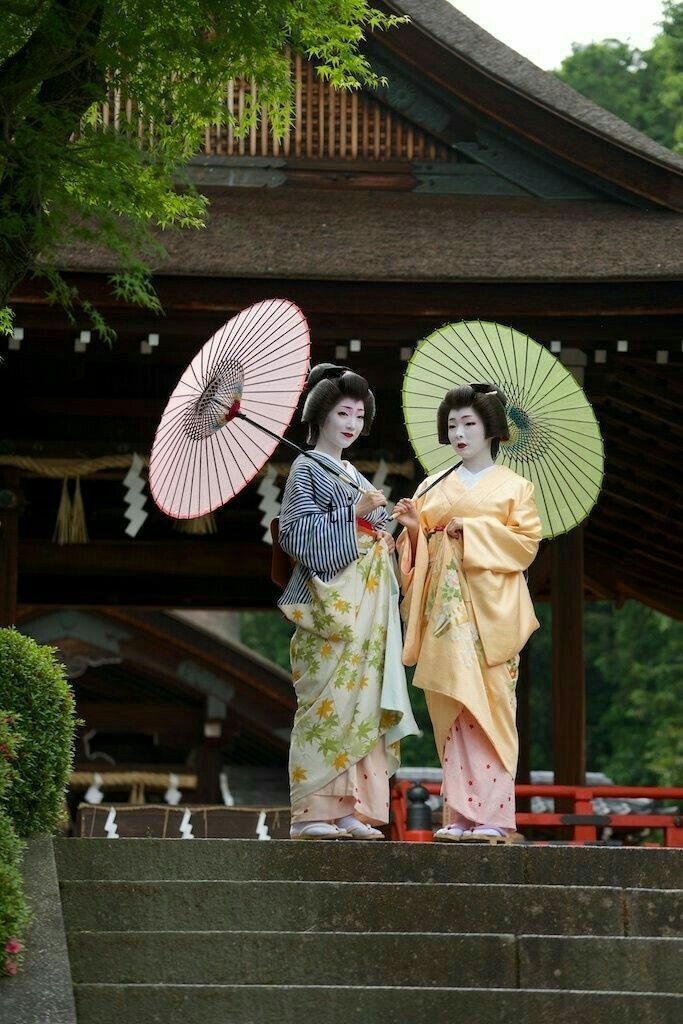
The procession consists of approximately 500 participants dressed in the court costumes of the Heian period — the era of The Tale of Genji, of elaborate layered silk robes in colour combinations that carried specific social and seasonal meaning, of a court culture so devoted to aesthetic refinement that the correct appreciation of a flower arrangement was considered as important a skill as military strategy.
The costumes — junihitoe for the highest-ranking women, formal court dress for the men, ceremonial armour for the guards — are not reproductions in any approximate sense. They are made to period specifications, using traditional techniques, and the layers of silk and the weight of the headdresses are such that participants must train for months to move in them with the slow, correct dignity the ceremony requires. The hollyhock motif — aoi — appears on every costume, every ox cart, every horse’s decoration: a plant associated in Shinto tradition with the Kamo deities, woven through the entire visual vocabulary of the day.
The Quality of the Procession
The procession leaves the Kyoto Imperial Palace at 10:30am and arrives at Shimogamo Shrine in the early afternoon, continuing to Kamigamo Shrine by mid-afternoon. The route covers approximately eight kilometres. The pace is what Japanese ceremonial culture calls yukkuri — unhurried, deliberate, calibrated not to the crowd’s attention span but to the ceremony’s internal logic.
There are no floats in the Gion Matsuri sense. No music in the Western festival sense — only the occasional sound of court instruments played at rest stops, a music so spare and so strange to ears trained on Western harmony that it registers initially as ambient rather than melodic. There are ox carts drawn by black-lacquered wheels. There are horses in ceremonial dress. There are bearers carrying imperial symbols — the sacred mirror, the bow, the arrows — in boxes so ornate that the containers seem more significant than whatever they contain.
And at the centre of the procession, carried in a palanquin, is the Saio-dai — a woman selected each year from Kyoto’s families to represent the imperial princess who, in the original ceremony, was sent to perform purification rituals at the Kamo shrines. The Saio-dai does not speak during the procession. She does not acknowledge the crowd. She faces forward with the particular stillness of someone performing not for an audience but for something older and less visible than one.
This is the quality that the camera struggles with. There is no climactic moment to photograph. The procession is not building toward anything. It simply proceeds, with the unhurried intentionality of a ritual that has been performed this way for over a millennium, and concludes at the shrine with ceremonies that take place out of public view.

Why It Survives What Other Festivals Haven’t
The Aoi Matsuri’s survival in its current form is not accidental. It is the result of a specific set of conditions — cultural, institutional, and financial — that have maintained the ceremony’s integrity against the pressures that have modified or commercialised many comparable events globally.
The procession is organised and funded by the Kyoto Imperial Household Agency and the two Kamo shrines, not by a tourism authority or a commercial festival organisation. The participants are drawn from specific families and institutions with historical connections to the ceremony — not from open auditions or paid performers. The costumes are maintained, repaired, and renewed by craftspeople working within the traditional textile industries of Kyoto — the same industries that produce the finest silk in Japan and whose survival is itself a cultural preservation question.
The result is a festival with no commercial sponsor, no merchandise stall at the route’s edge, no branded presence of any kind. The hollyhock decorations are real plants, gathered in the days before the procession from gardens maintained for exactly this purpose. The ceremony does not need an audience to justify its existence. It would proceed, in essentially identical form, regardless of whether anyone watched.
That self-sufficiency — rare in any cultural event in any country — is what gives the Aoi Matsuri its quality of genuine antiquity. It is not performing its history. It is its history, continuing.
Attending the Aoi Matsuri
The procession is free to observe along its entire route. The most atmospheric viewing points are at the Kyoto Imperial Palace for the departure, and along the Kamo River approach to Shimogamo Shrine, where the procession passes through ancient forest and the light filters through the canopy in ways that no urban section of the route replicates.
Seating in designated areas along the route requires tickets, bookable through Kyoto’s tourism authority from early May. Standing positions along the route itself are free but fill quickly — arriving at the Imperial Palace by 9:30am allows time to find position before the 10:30 departure.
May 15th falls in the middle of Kyoto’s spring tourist season. Accommodation books out months in advance for the festival date specifically. Arriving in Kyoto a day or two before and staying through the 16th allows the festival itself to breathe — to be attended at its own pace, without the compression of a single-day visit that turns ceremony into schedule.
The Aoi Matsuri does not reward urgency. It rewards presence. These are, in 2026, two different travel philosophies — and this festival, quietly, makes the case for one of them.